

Buffalo
A classic 1 oz .999 fine silver round featuring the iconic Native American and buffalo design.
Silver Eagle
The official U.S. 1 oz .999 fine silver bullion coin, trusted worldwide for purity and value.

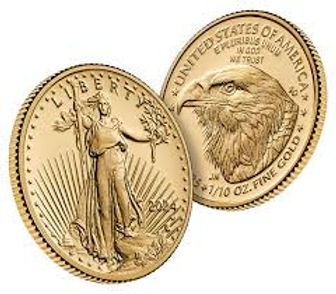
Gold Eagle
A U.S. Mint gold bullion coin containing 1 oz of pure gold in a durable 22-karat alloy.
Gold Buffalo
A premium U.S. Mint bullion coin struck in 1 oz of 99.99% pure gold with the iconic buffalo design.


Pre-33
US EAGLE
The Eagle was the United States $10 gold coin denomination issued until 1933. 0.48375 troy ounces of gold.
THE HALF EAGLE
The Half Eagle was the United States $5 gold piece and was struck until 1929. its gold content was of 0.24187, exactly half that of the Eagle.
THE QUARTER EAGLE
The $2.50 gold coin. It was produced, on and off, over the years until its final issue in 1929. It contained precisely 0.12094 troy ounces of gold, one quarter the amount of the Eagle.
THE DOUBLE EAGLE
The Gold Double Eagle was the $20 variation of the Eagle. Unlike the other Eagle denominations, the Double Eagle was always minted with 90% gold and 10% copper (as that was already the standard at the time of its inception). contained .9675 oz of gold.
THE GOLD DOLLAR
The Gold Dollar denomination was the one-dollar piece minted from 1849 to 1889. It was struck using 90% gold and 10% copper and contained 0.04837 troy ounces of gold (one tenth that of the Eagle).
THE THREE-DOLLAR PIECE
Mintage for the Three-Dollar gold piece began in 1854 and continued regularly until 1889. The $3 face value coin had .1451 troy ounces of gold.
90% Junk Silver
U.S. 90% silver coinage refers to circulating dimes, quarters, half dollars, and dollar coins minted in 1964 and earlier which contain a composition of 90% silver and 10% copper. These are often called "junk silver" or "constitutional silver" and are primarily valued for their intrinsic metal content.
Investors and collectors purchase these coins as a tangible asset and a hedge against inflation. They are popular for their divisibility and recognizability in potential bartering situations, often sold in large bags based on their total face value (e.g., $100 or $1,000 face value bags).

" The products listed here are not limited to the shops ability to source most materials customers could/would want. "
Contact
Monday – Friday: Appointment Only
7754930487
